Senator Kay Hagan discussed the sexual assault problem in the military on the Senate floor last week. She made good use of a scarf: http://youtu.be/cVi7vR4iSyQ
This outfit would certainly work without the scarf, but it's so much better with it. The key here, as it is in many cases, is that the scarf is not tied to tightly or too carefully. It's draped asymmetrically around her neck and not tied in a firm knot. Tucking it in (a little bit) to her jacket helps hold it in place.
Thursday, May 23, 2013


Monday, May 20, 2013
Classic leather
The House approved the Working Families Flexibility Act on May 8. For a press conference the day before, Rep. Cathy McMorris Rodgers wore a leather jacket: http://youtu.be/gVmkmlH0q5o
A leather jacket can send many different messages, depending on the style. Sarah Palin made it tough-but-feminine, Rosa DeLauro made it quirky.
In this example, Rep. McMorris Rodgers goes for an updated classic. The blazer style with buttons (as opposed to a motorcycle style with a lot of zippers) sends a preppy message, and the rich brown color is much softer than black but not as conspicuous as pink or red.
If you try this look, remember: simple shoes and a soft layer underneath.
A leather jacket can send many different messages, depending on the style. Sarah Palin made it tough-but-feminine, Rosa DeLauro made it quirky.
In this example, Rep. McMorris Rodgers goes for an updated classic. The blazer style with buttons (as opposed to a motorcycle style with a lot of zippers) sends a preppy message, and the rich brown color is much softer than black but not as conspicuous as pink or red.
If you try this look, remember: simple shoes and a soft layer underneath.
Tuesday, May 14, 2013
The number one question Hillary's pollsters need to ask
It's spring in an odd-numbered year, a quiet moment in national electoral politics. Political junkies pay too much attention to special elections, and then write about what they mean, and what they don't mean, and how we shouldn't draw any conclusions from them anyway.
It's also a moment when issue groups, taking the long view of electoral politics (at least in comparison to individual candidate campaigns) begin to set the stage for the following year and the next Administration. The big news on that front this month was the Madam President initiative launched by Emily's List. It's meant to be a full-throttle push for "any" woman president, but everyone knows that in 2016 that really means Hillary Clinton.
When she runs (and I believe she will run) she will certainly have a few things to learn from the Obama campaigns in 2008 and 2012. Much fanfare has been given to the Obama use of technology and micro-targeting techniques, but it may be several decades before analysts fully unpack the dynamics of those campaigns. One book attempting to do so is The Victory Lab by Sasha Issenberg. It's an extremely well-researched deep dive into the context and mechanics of how the Obama campaigns leveraged computer technology, statistics and polling to win the day. The overused but apt comparison is Moneyball for politics. Secretary Clinton's staff will absorb these techniques and build upon them for sure.
But here's where I think it gets interesting for women: statistical models that make predictions of voting behavior based on demographic and consumer information require past behavior to create the algorithms. Whenever you have a "first" candidate, the predictive power of the model is automatically weaker. Issenberg notes that the Obama campaign in 2008 made specific changes to its polling practices and resulting predictive models to avoid what is known as the Bradley Effect, where a voter will tell a pollster s/he will vote for a minority candidate (or is undecided) when in fact the voter ends up voting for the white candidate because of race. The candidate can appear ahead in the polls but still come up short at the polling place.
As a strategy, the Obama campaign didn't seek to change the minds of these voters. Instead, they simply wanted to exclude them from the get-out-the-vote efforts, which were the heart of the campaign's strategy. Identifying these voters turned out to be remarkably simple. According to Issenberg, the pollsters began to ask, "Do you think your neighbors would be willing to vote for an African-American president?" It turned out that most of the time, behavior attributed to "the neighbors" was really the voter's own, even if they couldn't admit it.
The numbers on likelihood to vote for a woman are surely too astonishing right now: 90% say they would, and 72% say they believe it's likely a woman will win in 2016. Could it be that simple to straighten this out? Is all we need to ask, "Would your neighbors vote for a woman president?" to get a clearer picture?
I promise this is not a test, but would your neighbors vote for a woman president? Would they vote for Hillary?
It's also a moment when issue groups, taking the long view of electoral politics (at least in comparison to individual candidate campaigns) begin to set the stage for the following year and the next Administration. The big news on that front this month was the Madam President initiative launched by Emily's List. It's meant to be a full-throttle push for "any" woman president, but everyone knows that in 2016 that really means Hillary Clinton.
When she runs (and I believe she will run) she will certainly have a few things to learn from the Obama campaigns in 2008 and 2012. Much fanfare has been given to the Obama use of technology and micro-targeting techniques, but it may be several decades before analysts fully unpack the dynamics of those campaigns. One book attempting to do so is The Victory Lab by Sasha Issenberg. It's an extremely well-researched deep dive into the context and mechanics of how the Obama campaigns leveraged computer technology, statistics and polling to win the day. The overused but apt comparison is Moneyball for politics. Secretary Clinton's staff will absorb these techniques and build upon them for sure.
But here's where I think it gets interesting for women: statistical models that make predictions of voting behavior based on demographic and consumer information require past behavior to create the algorithms. Whenever you have a "first" candidate, the predictive power of the model is automatically weaker. Issenberg notes that the Obama campaign in 2008 made specific changes to its polling practices and resulting predictive models to avoid what is known as the Bradley Effect, where a voter will tell a pollster s/he will vote for a minority candidate (or is undecided) when in fact the voter ends up voting for the white candidate because of race. The candidate can appear ahead in the polls but still come up short at the polling place.
As a strategy, the Obama campaign didn't seek to change the minds of these voters. Instead, they simply wanted to exclude them from the get-out-the-vote efforts, which were the heart of the campaign's strategy. Identifying these voters turned out to be remarkably simple. According to Issenberg, the pollsters began to ask, "Do you think your neighbors would be willing to vote for an African-American president?" It turned out that most of the time, behavior attributed to "the neighbors" was really the voter's own, even if they couldn't admit it.
The numbers on likelihood to vote for a woman are surely too astonishing right now: 90% say they would, and 72% say they believe it's likely a woman will win in 2016. Could it be that simple to straighten this out? Is all we need to ask, "Would your neighbors vote for a woman president?" to get a clearer picture?
I promise this is not a test, but would your neighbors vote for a woman president? Would they vote for Hillary?
Wednesday, May 1, 2013
Purple power
What would you wear to debate a man who is nationally known for a dramatic extramarital affair? Elizabeth Colbert Busch chose purple:
There is a really effective but subtle effect going on here: the color is feminine (no man in politics would wear a purple blazer), the cut is demure (the white blouse layered underneath makes it very modest), but at the same time it is tailored and that makes it just tough enough. Nothing about her femininity could be mistaken for weakness. It's a line that Gov. Nicki Haley also walks with success in the same state, South Carolina.
This special election is Tuesday, May 7.
There is a really effective but subtle effect going on here: the color is feminine (no man in politics would wear a purple blazer), the cut is demure (the white blouse layered underneath makes it very modest), but at the same time it is tailored and that makes it just tough enough. Nothing about her femininity could be mistaken for weakness. It's a line that Gov. Nicki Haley also walks with success in the same state, South Carolina.
This special election is Tuesday, May 7.
Monday, April 29, 2013
Bras, Spacesuits, and "Mission Accomplished"
One of these things is not like the other, right?
Not so fast. Ten year's after George W. Bush wore a flight suit on the deck of an aircraft carrier to declare "Mission Accomplished" in Iraq, it's a particularly interesting time to read Spacesuit: Fashioning Apollo by Nicholas de Monchaux. The form and function of the spacesuits American astronauts wore on the moon have more to do with politics, women, and fashion than you might think.
In what was probably the most significant intersection of the fashion industry and the military-industrial complex ever, the contract to build the spacesuits for NASA's Apollo missions that ultimately put a man on the moon went to the International Latex Corporation (ILC), the parent of Playtex. Although the ILC division making the spacesuits and the bra company Playtex ultimately split into separate businesses, de Monchaux explains that "until 1966, pipes of liquid latex ran to the dipping room [for spacesuit production] from the same tanks supplying girdle and bra assembly lines." This wasn't a coincidence, and it isn't an instance of space technology trickling down to the general public. In fact, it's the reverse. The first pressurized flight suits had their origins with companies that started out taking advantage of the advent of circular knitting machines in the 1930s to produce girdles and men's compression garments. (We may write about "men's shapewear" like it's a new phenomenon, but it's not.) The entry of the United States into World War II shifted production to high altitude flight suits for military pilots instead. At the same time, early latex technology at Playtex shifted from children's underwear and sheets to inflatable rafts for the military, and the firm's founder shifted his advertising budget to paid newspaper editorials in support of the Roosevelt Administration. But it was John F. Kennedy's vision that would take this fashion-military connection to a whole new level.
Kennedy's public commitment to putting a man on the moon was as much about image as it was about technological achievement. The race was on, literally, to accomplish every facet of that mission, including competition among multiple firms for the privilege of suiting up the men in space. And they were all men, with military backgrounds. While the decision to limit the astronaut corps to military pilots was initially made in an effort to protect classified military technology, it was conveyed to the public as being motivated by the superior physiological capacity of elite military pilots. In fact, the entire purpose of a spacesuit is to meet the finite human ability to withstand altitude and extend it, not to require some superior category of person. It was almost different: a NASA subcontractor, Dr. Richard Lovelace, performed a series of performance tests on women for readiness in space, finding equal ability and stamina to withstand altitude. He passed 13 women by 1961, but Vice President Johnson nixed the idea. Regardless of actual ability, women didn't fit the Cold War image of strength that the entire NASA acceleration was intended to convey.
So how did a company that started life making garments primarily for women and children end up making highly technical spacesuits for men? Superior performance, but it was hard won. The image of a "space man" had begun forming decades before, and its futuristic elements were well known - a space suit was smooth, modular, and shiny. There were some technical advantages to these features with respect to pressurization, and many of the prototype suits produced by ILC's competitors had a smooth, sturdy, impenetrable look. The problem, ironically, was space. Space capsules and lunar modules left the astronauts very little room to maneuver, yet they had to be able to perform complex tasks related to flight, and ultimately extricate themselves from the spacecraft out into space and on to the moon. Have you ever worn a Halloween costume that started out as a cardboard box? And then tried to get in and out of a small car while wearing it? Not easy. Now imagine trying that in space.
The ILC suit, by contrast, was made of 21 soft textile layers, handcrafted on specially modified sewing machines by master seamstresses originally trained in the high-precision sewing of bras and other garments. Not only were these suits far more easily maneuvered, they were more comfortable, incorporating a layer of girdle lining fabric between the astronaut's skin and the rubberized layers above it. But superior functionality was not entirely enough to win the contract - image was important too. At one point, ILC submitted to NASA along with its prototype suits a short film of two of their engineers playing football, with one of them wearing the spacesuit. This iconic image of American masculinity said more than any technical specifications on durability, comfort, and mobility could convey. ILC won the contract, and they still make space suits today.
So what does this have to do with politics? John Glenn, the first American to orbit the earth, served 24 years in the United State Senate.
The image of flight suits and space suits are associated with superior physical and technical ability expressly by design. The American public was told over and over for a decade that these military men wearing strange, rarefied garments were the best of the best, as close to elite beings as we could find to send into space. The suit became a powerful visual shorthand for excellence. It would be 20 years before a woman publicly joined that club.
When President George W. Bush appeared before a national audience wearing a flight suit to declare "Mission Accomplished," what did it mean? I expect we'll see a lot of interesting analysis this week in hindsight, but at the time the visual message was quite clearly expressed in the media: strength, vigor, leadership, and sex appeal. He had the equipment to fly as high as man can go.
For women, the potential of these images is just beginning. This term we saw two female veterans elected to Congress: Tammy Duckworth and Tulsi Gabbard. As a double-amputee and former Secretary of Veterans Affairs, we've already become accustomed to associating Duckworth's image with military service. But it remains to be seen whether in this era of roadside bombs and women in combat whether it's our perception of women or of military service that will change. Commercial spaceflight could make the spacesuit part of anyone's wardrobe for the right price, which might say "luxury" but it doesn't say "elite." The days of the high flying leader might be over, and that might be ok.
This post is the first in a new series examining historical, sociological, psychological and artistic influences on the effects of image in politics, in preparation for my first book.
Not so fast. Ten year's after George W. Bush wore a flight suit on the deck of an aircraft carrier to declare "Mission Accomplished" in Iraq, it's a particularly interesting time to read Spacesuit: Fashioning Apollo by Nicholas de Monchaux. The form and function of the spacesuits American astronauts wore on the moon have more to do with politics, women, and fashion than you might think.
 |
| Unpacking the space suit. Courtesy NASA The Commons on Flickr. |
In what was probably the most significant intersection of the fashion industry and the military-industrial complex ever, the contract to build the spacesuits for NASA's Apollo missions that ultimately put a man on the moon went to the International Latex Corporation (ILC), the parent of Playtex. Although the ILC division making the spacesuits and the bra company Playtex ultimately split into separate businesses, de Monchaux explains that "until 1966, pipes of liquid latex ran to the dipping room [for spacesuit production] from the same tanks supplying girdle and bra assembly lines." This wasn't a coincidence, and it isn't an instance of space technology trickling down to the general public. In fact, it's the reverse. The first pressurized flight suits had their origins with companies that started out taking advantage of the advent of circular knitting machines in the 1930s to produce girdles and men's compression garments. (We may write about "men's shapewear" like it's a new phenomenon, but it's not.) The entry of the United States into World War II shifted production to high altitude flight suits for military pilots instead. At the same time, early latex technology at Playtex shifted from children's underwear and sheets to inflatable rafts for the military, and the firm's founder shifted his advertising budget to paid newspaper editorials in support of the Roosevelt Administration. But it was John F. Kennedy's vision that would take this fashion-military connection to a whole new level.
 |
| Gemini VIII astronauts. Courtesy NASA The Commons on Flickr. |
Kennedy's public commitment to putting a man on the moon was as much about image as it was about technological achievement. The race was on, literally, to accomplish every facet of that mission, including competition among multiple firms for the privilege of suiting up the men in space. And they were all men, with military backgrounds. While the decision to limit the astronaut corps to military pilots was initially made in an effort to protect classified military technology, it was conveyed to the public as being motivated by the superior physiological capacity of elite military pilots. In fact, the entire purpose of a spacesuit is to meet the finite human ability to withstand altitude and extend it, not to require some superior category of person. It was almost different: a NASA subcontractor, Dr. Richard Lovelace, performed a series of performance tests on women for readiness in space, finding equal ability and stamina to withstand altitude. He passed 13 women by 1961, but Vice President Johnson nixed the idea. Regardless of actual ability, women didn't fit the Cold War image of strength that the entire NASA acceleration was intended to convey.
So how did a company that started life making garments primarily for women and children end up making highly technical spacesuits for men? Superior performance, but it was hard won. The image of a "space man" had begun forming decades before, and its futuristic elements were well known - a space suit was smooth, modular, and shiny. There were some technical advantages to these features with respect to pressurization, and many of the prototype suits produced by ILC's competitors had a smooth, sturdy, impenetrable look. The problem, ironically, was space. Space capsules and lunar modules left the astronauts very little room to maneuver, yet they had to be able to perform complex tasks related to flight, and ultimately extricate themselves from the spacecraft out into space and on to the moon. Have you ever worn a Halloween costume that started out as a cardboard box? And then tried to get in and out of a small car while wearing it? Not easy. Now imagine trying that in space.
 |
| Apollo 9 astronauts. Courtesy NASA The Commons on Flickr. |
The ILC suit, by contrast, was made of 21 soft textile layers, handcrafted on specially modified sewing machines by master seamstresses originally trained in the high-precision sewing of bras and other garments. Not only were these suits far more easily maneuvered, they were more comfortable, incorporating a layer of girdle lining fabric between the astronaut's skin and the rubberized layers above it. But superior functionality was not entirely enough to win the contract - image was important too. At one point, ILC submitted to NASA along with its prototype suits a short film of two of their engineers playing football, with one of them wearing the spacesuit. This iconic image of American masculinity said more than any technical specifications on durability, comfort, and mobility could convey. ILC won the contract, and they still make space suits today.
So what does this have to do with politics? John Glenn, the first American to orbit the earth, served 24 years in the United State Senate.
 |
| John Glenn entering Friendship 7 in a test facility. Courtesy NASA The Commons on Flickr. |
The image of flight suits and space suits are associated with superior physical and technical ability expressly by design. The American public was told over and over for a decade that these military men wearing strange, rarefied garments were the best of the best, as close to elite beings as we could find to send into space. The suit became a powerful visual shorthand for excellence. It would be 20 years before a woman publicly joined that club.
 |
| First class of female astronauts, 1979. Courtesy NASA The Commons on Flickr. |
When President George W. Bush appeared before a national audience wearing a flight suit to declare "Mission Accomplished," what did it mean? I expect we'll see a lot of interesting analysis this week in hindsight, but at the time the visual message was quite clearly expressed in the media: strength, vigor, leadership, and sex appeal. He had the equipment to fly as high as man can go.
For women, the potential of these images is just beginning. This term we saw two female veterans elected to Congress: Tammy Duckworth and Tulsi Gabbard. As a double-amputee and former Secretary of Veterans Affairs, we've already become accustomed to associating Duckworth's image with military service. But it remains to be seen whether in this era of roadside bombs and women in combat whether it's our perception of women or of military service that will change. Commercial spaceflight could make the spacesuit part of anyone's wardrobe for the right price, which might say "luxury" but it doesn't say "elite." The days of the high flying leader might be over, and that might be ok.
This post is the first in a new series examining historical, sociological, psychological and artistic influences on the effects of image in politics, in preparation for my first book.
Tuesday, April 9, 2013
How Margaret Thatcher became a style role model
Don't get me wrong. For all the photo essays reviewing Margaret Thatcher's style this week, no one would ever mistake her for a fashion plate. But she was the first female elected leader of a major Western country, and that made her a role model just by virtue of her existence.
Want to know what a woman in power looks like? Margaret Thatcher was among the first very prominent examples:
Like some American leaders we know, she was asked by the press about her style and beauty habits. It was inane, but that's not to say that we can't learn something from her:
"There is a nonsense about intelligent women not being beautiful. There is no genetic link between brains and beauty. Most women are far more intelligent than people give them credit for."
Want to know what a woman in power looks like? Margaret Thatcher was among the first very prominent examples:
Like some American leaders we know, she was asked by the press about her style and beauty habits. It was inane, but that's not to say that we can't learn something from her:
- Devise a go-to outfit that works for you. It should be comfortable, professional, easy to assemble, and endlessly repeatable without being cartoonish.
- Same goes for your handbag.
- Take your makeup off every night, and not with soap if you can avoid it.
Saturday, March 30, 2013
We won't have more women in office
At least not any time soon, not if we keep this up. That's the message we heard (loudly) this week with the release of a new study from the Women & Politics Institute at American University. It's worth the 20 minutes to read the study itself, I promise.
The main take away is this: We need to spend more time encouraging women to run for office. All women, but especially young women. And all offices, even college student government. Now, I don't want to say I told you so, but I did. It's not too late to keep that New Year's Resolution.
Another take away from the study has gotten even more attention: it means more for a young woman's future political ambition to work and be involved in politics at all than it does to simply have the role models of women in office in front of her. Here's how study co-author Jennifer Lawless put it to the Atlantic:
Ok, so how do we get more young women working in politics? There are some remarkable resources. Here are a few:
The Star Fellowship at Running Start. This program not only places college women in internships on Capitol Hill with housing and a living stipend but also provides them with ongoing mentoring and support throughout their time in Washington and long after they leave. Applications for Fall 2013 are due April 8!!!
The Women's Congressional Staff Association. More than just a networking group for Hill staffers (although it's that too) WCSA runs a mentoring program that pairs staffers with more senior women on the Hill for four-month stints. In a unique twist, the program requires all women requesting a mentor to also serve as a mentor to someone more junior than herself. This not only solves the problem of a shortage of mentors that some programs have, but also reminds even relatively junior staffers that they have something valuable to offer others.
Do you have other ideas? An opening in your office? Comment below!
The main take away is this: We need to spend more time encouraging women to run for office. All women, but especially young women. And all offices, even college student government. Now, I don't want to say I told you so, but I did. It's not too late to keep that New Year's Resolution.
Another take away from the study has gotten even more attention: it means more for a young woman's future political ambition to work and be involved in politics at all than it does to simply have the role models of women in office in front of her. Here's how study co-author Jennifer Lawless put it to the Atlantic:
"Certainly having Nancy Pelosi be speaker of the House suggests that a woman can get elected and become speaker of the House and that's a vital ingredient," Lawless said. "But having an internship in any member of Congress' office probably confers a greater degree of confidence, experience, skills, and interest in terms of someone's own future potential candidacy than the mere presence of a female speaker."
Ok, so how do we get more young women working in politics? There are some remarkable resources. Here are a few:
The Star Fellowship at Running Start. This program not only places college women in internships on Capitol Hill with housing and a living stipend but also provides them with ongoing mentoring and support throughout their time in Washington and long after they leave. Applications for Fall 2013 are due April 8!!!
The Women's Congressional Staff Association. More than just a networking group for Hill staffers (although it's that too) WCSA runs a mentoring program that pairs staffers with more senior women on the Hill for four-month stints. In a unique twist, the program requires all women requesting a mentor to also serve as a mentor to someone more junior than herself. This not only solves the problem of a shortage of mentors that some programs have, but also reminds even relatively junior staffers that they have something valuable to offer others.
Do you have other ideas? An opening in your office? Comment below!
Tuesday, March 5, 2013
Take a cue from Pelosi
It's March. Soon we'll see daffodils and winter coat sales popping up everywhere. As eager as you are for spring, snagging that coat now and stashing it in your closet until November is a great investment. I hope you'll consider a brightly colored coat, which is one of the great joys of women's apparel. You should try Boden - they have some great colors.
Need some inspiration? Here's Nancy Pelosi in rich violet at a rally on the Voting Rights Act:
Need some inspiration? Here's Nancy Pelosi in rich violet at a rally on the Voting Rights Act:
Thursday, February 28, 2013
How to wear emerald
You may have heard: Pantone's color of the year for 2013 is emerald. (Pantone is a color system and forecasting service. Now you know.)
Rep. Michele Bachmann selected emerald for a hearing with Federal Reserve Chairman Ben Bernanke: http://youtu.be/NsZaaV5JSEs
Emerald is a strong color, but many people can wear it. The key is to break it up a little bit, as Rep. Bachmann has done here with a necklace. She also kept her makeup strong, preventing the color from washing her out.
Here's how you can wear emerald too:


Rep. Michele Bachmann selected emerald for a hearing with Federal Reserve Chairman Ben Bernanke: http://youtu.be/NsZaaV5JSEs
Emerald is a strong color, but many people can wear it. The key is to break it up a little bit, as Rep. Bachmann has done here with a necklace. She also kept her makeup strong, preventing the color from washing her out.
Here's how you can wear emerald too:
Wednesday, February 20, 2013
Day or evening?
Baltimore Mayor Stephanie Rawlings-Blake held a press conference this week on her ten year fiscal forecast. She wore gray: http://youtu.be/oNEfEN9kRgo
This would be a really lovely look for an evening out to dinner or the theater. This cool gray compliments the Mayor's skin tone, and the necklace hits her first balance point perfectly. But the richness of having multiple textures and patterns, a grosgrain ribbon edge to the jacket, and shiny rhinestones on the necklace take this outfit out of the "work" space and into something more social. The high neckline keeps us out of "date night with Fox" territory, but I would have still recommended a much more businesslike look for such a businesslike subject.
This would be a really lovely look for an evening out to dinner or the theater. This cool gray compliments the Mayor's skin tone, and the necklace hits her first balance point perfectly. But the richness of having multiple textures and patterns, a grosgrain ribbon edge to the jacket, and shiny rhinestones on the necklace take this outfit out of the "work" space and into something more social. The high neckline keeps us out of "date night with Fox" territory, but I would have still recommended a much more businesslike look for such a businesslike subject.
Thursday, February 14, 2013
What it means to be part of the conversation
I just got back from the IFB conference. Here's what I learned:

- If I really think you need me, gentle readers, (and I do) then I have to give you what you need. More posts in 2013!
- If you want people to listen to you, you should have something to say. I learned that from my new blog crush, Hilary Rushford of Dean Street Society. Ok, I already new that, but I just like Hilary.
- What we say matters, but how we say it matters too. I learned that from Neil Blumenthal, co-founder of Warby Parker. Here is is in front of a slide of their super cool mobile pop-up shop on a school bus:

Tuesday, January 8, 2013
New Year's Resolutions
Have you made any New Year's Resolutions? Have you broken them already? Still searching?
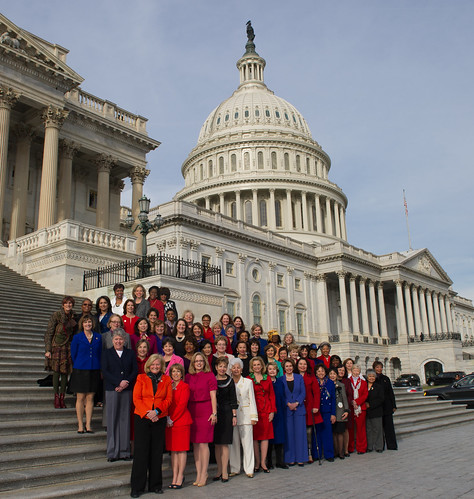
Photo courtesy of Nancy Pelosi's photostream on Flickr
Resolve to have some style in politics:
1. Show a girl she can lead. Highlight good examples. Be a good example yourself. Consider supporting one of the many wonderful organizations that support girls in leadership - I like Running Start.
2. Support a woman running for office. Look high AND low - the House is full now, but your county, city or school board may have elections this fall or even this spring. And again, there are incredible organizations like Emily's List to help you support some of them.
3. Seriously consider running for office yourself. We know that one reason we don't have anywhere near gender parity in elected office (even in this banner year for Congress) is that not enough women run for office to begin with. Don't imagine that you aren't qualified or aren't ready. You probably are, and if you aren't you can get there. And guess what? You don't have to have it all perfectly figured out. Consider a few tools, like Kathy Groob's excellent Pink Politics guide to preparing for a campaign.
Photo courtesy of Nancy Pelosi's photostream on Flickr
Resolve to have some style in politics:
1. Show a girl she can lead. Highlight good examples. Be a good example yourself. Consider supporting one of the many wonderful organizations that support girls in leadership - I like Running Start.
2. Support a woman running for office. Look high AND low - the House is full now, but your county, city or school board may have elections this fall or even this spring. And again, there are incredible organizations like Emily's List to help you support some of them.
3. Seriously consider running for office yourself. We know that one reason we don't have anywhere near gender parity in elected office (even in this banner year for Congress) is that not enough women run for office to begin with. Don't imagine that you aren't qualified or aren't ready. You probably are, and if you aren't you can get there. And guess what? You don't have to have it all perfectly figured out. Consider a few tools, like Kathy Groob's excellent Pink Politics guide to preparing for a campaign.
Subscribe to:
Comments (Atom)


 Posts
Posts




